Hyperbaric Oxygen Therapy for Anti-Aging: Telomeres, Stem Cells & Longevity
A 2020 clinical trial at Tel Aviv University found that 60 sessions of hyperbaric oxygen therapy lengthened telomeres by up to 38% and reduced senescent cells by up to 37% in adults over 64. These two biological markers are among the most reliable indicators of cellular aging, and this was the first time any intervention reversed both in humans without drugs, supplements, or genetic modification.
If you have been hearing about hyperbaric oxygen therapy in the context of longevity and anti-aging, you are not alone. Interest has surged as biohackers, longevity researchers, and wellness-focused consumers discover what clinical studies show about pressurized oxygen and biological age. This guide breaks down the research on telomere lengthening, stem cell mobilization, cognitive enhancement, and skin rejuvenation so you can decide whether hyperbaric oxygen therapy fits your health goals.
How hyperbaric oxygen therapy affects aging at the cellular level
Aging is driven by measurable biological processes. Two of the most studied are telomere shortening and senescent cell accumulation. Telomeres are protective caps on the ends of chromosomes. Every time a cell divides, telomeres get shorter. When they become too short, the cell stops functioning properly or dies. Senescent cells are "zombie cells" that have stopped dividing but refuse to die. They accumulate with age and release inflammatory signals that damage surrounding healthy tissue.
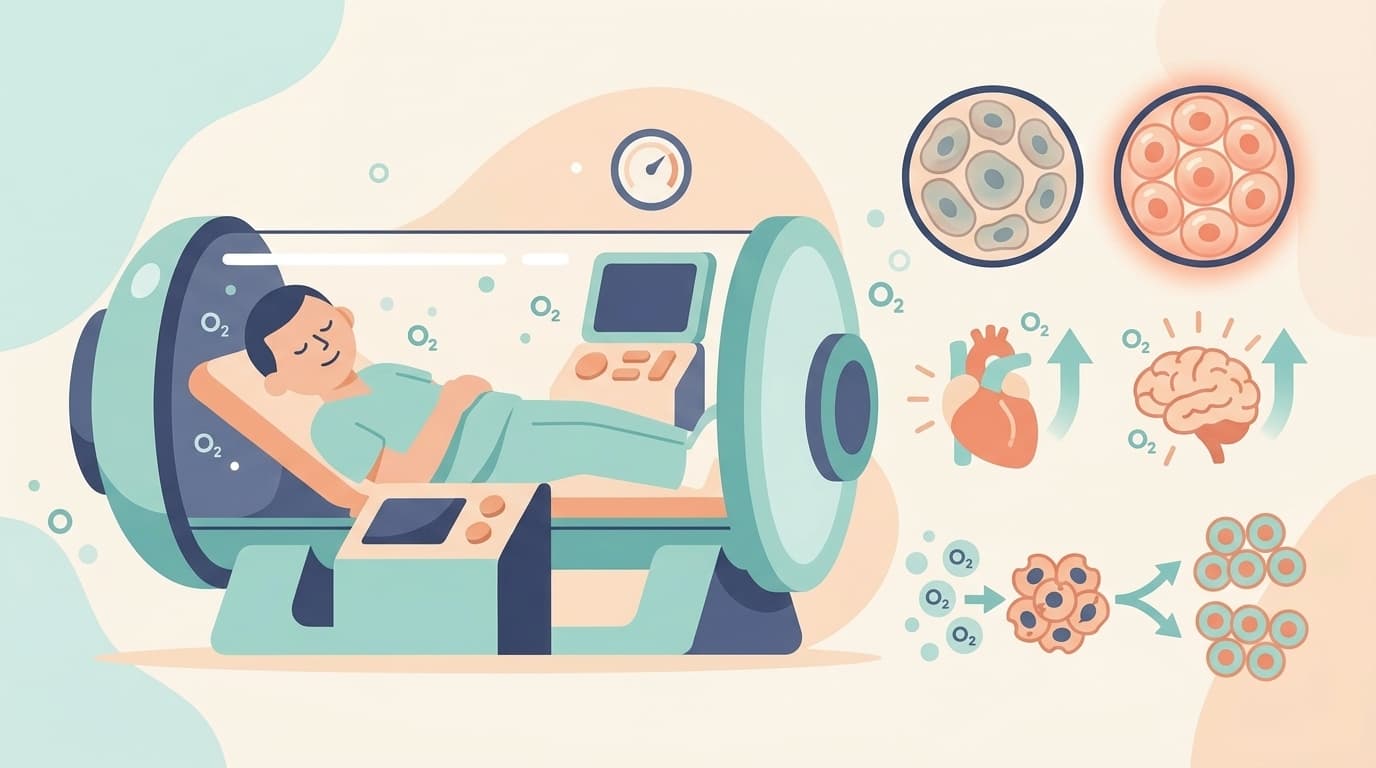
Hyperbaric oxygen therapy works through what researchers call the hyperoxic-hypoxic paradox. During treatment, you breathe 100% oxygen at 2.0 atmospheres absolute (ATA) in a pressurized chamber. Between sessions, your body returns to normal oxygen levels. This cycling between high and normal oxygen triggers adaptive responses similar to what happens at high altitude, including increased production of antioxidant enzymes, growth factors, and stem cells.
A 2024 review in Frontiers in Aging found that this process affects nearly 40% of protein-coding genes, influencing everything from inflammation to cellular repair. The combined effect of pressure and oxygen creates conditions that standard oxygen supplementation cannot replicate.
The telomere study: 38% lengthening in 60 sessions
The landmark study on hyperbaric oxygen therapy and telomeres was published in Aging in November 2020 by researchers at Tel Aviv University and Shamir Medical Center. It remains one of the most cited pieces of evidence in the HBOT longevity space.
Study design
Thirty-five healthy adults aged 64 and older received 60 daily hyperbaric oxygen therapy sessions over 90 days. Each session lasted 90 minutes at 2.0 ATA with 100% oxygen, including five-minute air breaks every 20 minutes. Blood samples were collected at baseline, after 30 sessions, after 60 sessions, and one to two weeks after the final session.
Key results
| Cell type | Telomere lengthening | Senescent cell reduction |
|---|---|---|
| T helper cells | +20.3% | -37.3% |
| T cytotoxic cells | +25.4% | -11.0% |
| Natural killer cells | +20.6% | Not reported |
| B cells | +25.7% to +37.6% | Not reported |
B cells showed the most dramatic response, with telomere lengthening reaching 37.6% at certain measurement points. The senescent cell clearance was most pronounced in T helper cells, where 37.3% of senescent cells were eliminated.
These results are significant because no pharmaceutical intervention had previously demonstrated simultaneous telomere lengthening and senescent cell clearance in humans. The five-minute air breaks during each session appear critical. They create the oxygen fluctuations that trigger the body's adaptive response.
If you are exploring longevity-focused treatments, you can browse anti-aging and longevity clinics on FindHBOT to compare options near you.
Stem cell mobilization: eightfold increase in circulating stem cells
Beyond telomeres, hyperbaric oxygen therapy has a well-documented effect on stem cell mobilization. Stem cells are your body's repair system. They can develop into many different cell types and play a central role in tissue regeneration.
A study published in the American Journal of Physiology found that a single two-hour hyperbaric oxygen exposure at 2.0 ATA doubled the number of circulating CD34+ stem cells. After 20 treatments, circulating CD34+ cells increased eightfold. The mechanism involves stimulation of nitric oxide synthesis in bone marrow, which releases stem cells into the bloodstream.
This matters for anti-aging because stem cell populations decline with age. By age 60, your circulating stem cell count may be a fraction of what it was at 25. Mobilizing these cells through hyperbaric oxygen therapy could support tissue repair, vascular health, and overall regenerative capacity.
What the stem cell research means for longevity
The stem cell effect connects to several pathways relevant to aging:
- Angiogenesis: New blood vessel formation improves oxygen delivery to tissues
- Tissue repair: Mobilized stem cells can migrate to damaged areas and support healing
- Vascular health: Improved endothelial function supports cardiovascular aging
- Growth factor release: HBOT stimulates vascular endothelial growth factor (VEGF), which supports tissue maintenance
These are not theoretical mechanisms. They have been observed in clinical settings across multiple studies. However, the long-term anti-aging implications of repeated stem cell mobilization are still being studied.
Cognitive enhancement in healthy older adults
One of the most practical benefits of hyperbaric oxygen therapy for aging adults is its effect on brain function. Cognitive decline is one of the most feared aspects of aging, and the research on HBOT and cognitive performance is encouraging.
A randomized controlled trial published in Aging in 2020 enrolled 63 healthy adults over 64. Thirty-three received hyperbaric oxygen therapy, and 30 served as controls. The HBOT group completed 60 sessions over three months.
Cognitive improvements measured
The study found a significant improvement in global cognitive function (p=0.0017) in the HBOT group compared to controls. The most notable gains were:
- Attention: Net effect size of 0.745
- Information processing speed: Net effect size of 0.788
- Executive function: Significant improvement
Brain imaging using perfusion MRI revealed that these cognitive gains correlated with increased cerebral blood flow in specific brain regions. The oxygen-rich environment appears to improve blood flow to areas of the brain that typically receive less perfusion as we age.
For anyone researching how to maintain cognitive sharpness with age, these results suggest that hyperbaric oxygen therapy offers measurable improvements in the exact domains that decline most with aging. You can learn more about neurological applications of HBOT, including research on traumatic brain injury and concussion recovery.
Skin aging: collagen, elasticity, and blood vessel formation
Aging skin is one of the most visible signs of biological aging. A 2021 prospective clinical trial published in Aging examined whether hyperbaric oxygen therapy could reverse the pathophysiology of skin aging at the tissue level.
Study findings
After 60 sessions of hyperbaric oxygen therapy, researchers documented:
- Significant increase in collagen density (p<0.001)
- Significant increase in elastic fiber length (p<0.0001)
- Increased number of blood vessels (p=0.02)
- Decreased fiber fragmentation
- Reduction in tissue senescent cells
The mechanism involves two key processes: angiogenesis (formation of new blood vessels that deliver more oxygen and nutrients to skin tissue) and senescent cell clearance (removal of damaged cells that contribute to skin degradation).
This was the first human study to demonstrate that hyperbaric oxygen therapy can reverse skin aging at the cellular and tissue level, not just improve surface appearance. The changes occurred in the deep dermal layer where collagen and elastic fibers provide structural support.
What a typical anti-aging HBOT protocol looks like
Based on the clinical research, the standard protocol used in longevity studies follows a consistent pattern:
| Protocol element | Details |
|---|---|
| Pressure | 2.0 ATA |
| Oxygen | 100% (medical-grade) |
| Session length | 90 minutes |
| Air breaks | 5 minutes every 20 minutes |
| Frequency | 5 sessions per week |
| Total sessions | 60 |
| Duration | 12 weeks (3 months) |
| Chamber type | Hard-shell (monoplace or multiplace) |
Important notes about the protocol
The air breaks are not optional. The cycling between 100% oxygen and normal air creates the hyperoxic-hypoxic paradox that drives the biological response. Sessions without air breaks may not produce the same telomere or senescent cell effects.
The 2.0 ATA pressure requires a hard-shell hyperbaric chamber. Soft-shell chambers typically operate at 1.3 to 1.5 ATA and cannot reach the pressures used in the telomere and cognitive studies. If anti-aging benefits based on this research are your goal, you need a clinic with medical-grade hard-shell chambers.
The cost of 60 sessions varies by location, typically ranging from $12,000 to $24,000 for the full protocol. Hyperbaric oxygen therapy for anti-aging is not FDA-approved and is considered off-label, so insurance does not cover it. You can check our guide to HBOT costs for a detailed pricing breakdown.
Is hyperbaric oxygen therapy FDA-approved for anti-aging?
No. Hyperbaric oxygen therapy is not FDA-approved for anti-aging, longevity, or telomere lengthening. The FDA currently approves HBOT for 14 specific medical conditions, including wound healing, decompression sickness, and carbon monoxide poisoning.
Anti-aging use is considered off-label. This means:
- A doctor can prescribe it, but insurance will not cover it
- The research is promising but not yet sufficient for FDA review
- Clinics offering HBOT for longevity are providing off-label treatments
- You should look for clinics with physician oversight and UHMS accreditation
The distinction matters because it affects cost, insurance coverage, and how you should evaluate claims from clinics marketing anti-aging HBOT. Clinics making guarantees about reversing aging should raise a red flag. The research is compelling but still evolving.
Who is exploring HBOT for longevity?
Interest in hyperbaric oxygen therapy for anti-aging spans several groups:
Biohackers and longevity enthusiasts represent the largest segment. People like Dave Asprey and Bryan Johnson have popularized HBOT as part of comprehensive anti-aging protocols. They are drawn to the telomere data and the fact that HBOT is non-pharmaceutical.
Athletes over 40 are another growing demographic. Many professional athletes already use HBOT for sports recovery. As they age, the longevity benefits become an additional reason to continue treatment.
Adults managing cognitive decline concerns make up a third group. The cognitive enhancement data is particularly compelling for people in their 50s and 60s who want to maintain mental sharpness.
FindHBOT lists 849 clinics that offer services related to anti-aging and longevity. You can browse anti-aging clinics and filter by location, chamber type, and specialization.
Frequently asked questions
Can hyperbaric oxygen therapy actually reverse aging?
Clinical research shows that HBOT can reverse two key biological markers of aging: telomere shortening and senescent cell accumulation. A 2020 study found telomere lengthening of up to 38% and senescent cell reduction of up to 37% after 60 sessions. However, "reversing aging" is complex, and these cellular changes may not translate to all aspects of aging equally.
How many HBOT sessions do you need for anti-aging benefits?
The clinical studies showing telomere lengthening and cognitive improvement used 60 sessions over 12 weeks, with five sessions per week. Some benefits may begin earlier, but the full protocol appears necessary for the telomere and senescent cell effects documented in the research.
Does insurance cover HBOT for anti-aging?
No. Anti-aging is not an FDA-approved indication for hyperbaric oxygen therapy, so insurance does not cover it. Expect to pay out of pocket, typically $200 to $400 per session or $12,000 to $24,000 for a full 60-session protocol. Read our insurance coverage guide for details on covered conditions.
Are soft-shell chambers effective for anti-aging?
The clinical studies on telomere lengthening and cognitive enhancement used hard-shell chambers at 2.0 ATA with 100% oxygen. Soft-shell chambers operate at lower pressures (1.3 to 1.5 ATA) and cannot deliver 100% oxygen. There is no published evidence that soft-shell chambers produce the same anti-aging effects documented in the research.
What are the risks of HBOT for anti-aging?
Hyperbaric oxygen therapy is generally safe when administered in a clinical setting. Common side effects include temporary ear pressure, mild fatigue, and short-term vision changes. Serious complications are rare. Read our full side effects guide for a complete breakdown.
The bottom line on hyperbaric oxygen therapy and anti-aging
The research on hyperbaric oxygen therapy for anti-aging is among the most exciting in the longevity space. The evidence shows measurable effects on telomere length, senescent cell clearance, stem cell mobilization, cognitive function, and skin aging. No other single non-pharmaceutical intervention has demonstrated this range of anti-aging effects in clinical trials.
That said, this is still emerging science. The studies involve relatively small sample sizes (35 to 63 participants). Long-term follow-up data beyond one year is limited. And the 60-session protocol represents a significant investment of time and money.
If you are considering hyperbaric oxygen therapy for longevity, look for clinics with hard-shell chambers, physician oversight, and experience with the 60-session protocol. Ask about air break protocols and pressure settings to ensure they match what the research used.
Ready to explore your options? Browse 849+ anti-aging and longevity clinics on FindHBOT, or search all 2,400+ clinics to find a provider near you.
Sources
-
Hachmo, Y., et al. (2020). "Hyperbaric oxygen therapy increases telomere length and decreases immunosenescence in isolated blood cells: a prospective trial." Aging, 12(22). PubMed
-
Hadanny, A., et al. (2020). "Cognitive enhancement of healthy older adults using hyperbaric oxygen: a randomized controlled trial." Aging, 12(13). PMC
-
Hachmo, Y., et al. (2021). "The effect of hyperbaric oxygen therapy on the pathophysiology of skin aging: a prospective clinical trial." Aging, 13(22). PubMed
-
Thom, S.R., et al. (2006). "Stem cell mobilization by hyperbaric oxygen." American Journal of Physiology - Heart and Circulatory Physiology, 290(4). PubMed
-
Lindenmann, J., et al. (2024). "Hyperbaric oxygen therapy: future prospects in regenerative therapy and anti-aging." Frontiers in Aging, 5. Frontiers
-
Hadanny, A., et al. (2024). "Physical enhancement of older adults using hyperbaric oxygen: a randomized controlled trial." BMC Geriatrics, 24. Springer
This article is for informational purposes only and does not constitute medical advice. Always consult a qualified healthcare provider before starting any treatment, including hyperbaric oxygen therapy.
Related Articles
 conditions
Hyperbaric Oxygen Therapy for Multiple Sclerosis: What the Evidence Shows
Can hyperbaric oxygen therapy help MS symptoms like fatigue and bladder dysfunction? We review the clinical evidence, including the Cochrane analysis of 504 patients across 9 trials.
 conditions
Hyperbaric Oxygen Therapy for Cerebral Palsy: What Parents Need to Know
Learn what research shows about hyperbaric oxygen therapy for cerebral palsy, including clinical evidence, treatment protocols for children, safety data, costs, and how to find the right pediatric HBOT clinic.
 conditions
Hyperbaric Oxygen Therapy for PTSD and Veterans: Hope Beyond Traditional Treatment
A 2024 clinical trial found nearly 40% PTSD symptom reduction in veterans after 60 HBOT sessions. Learn what the research shows and find clinics that treat PTSD.